
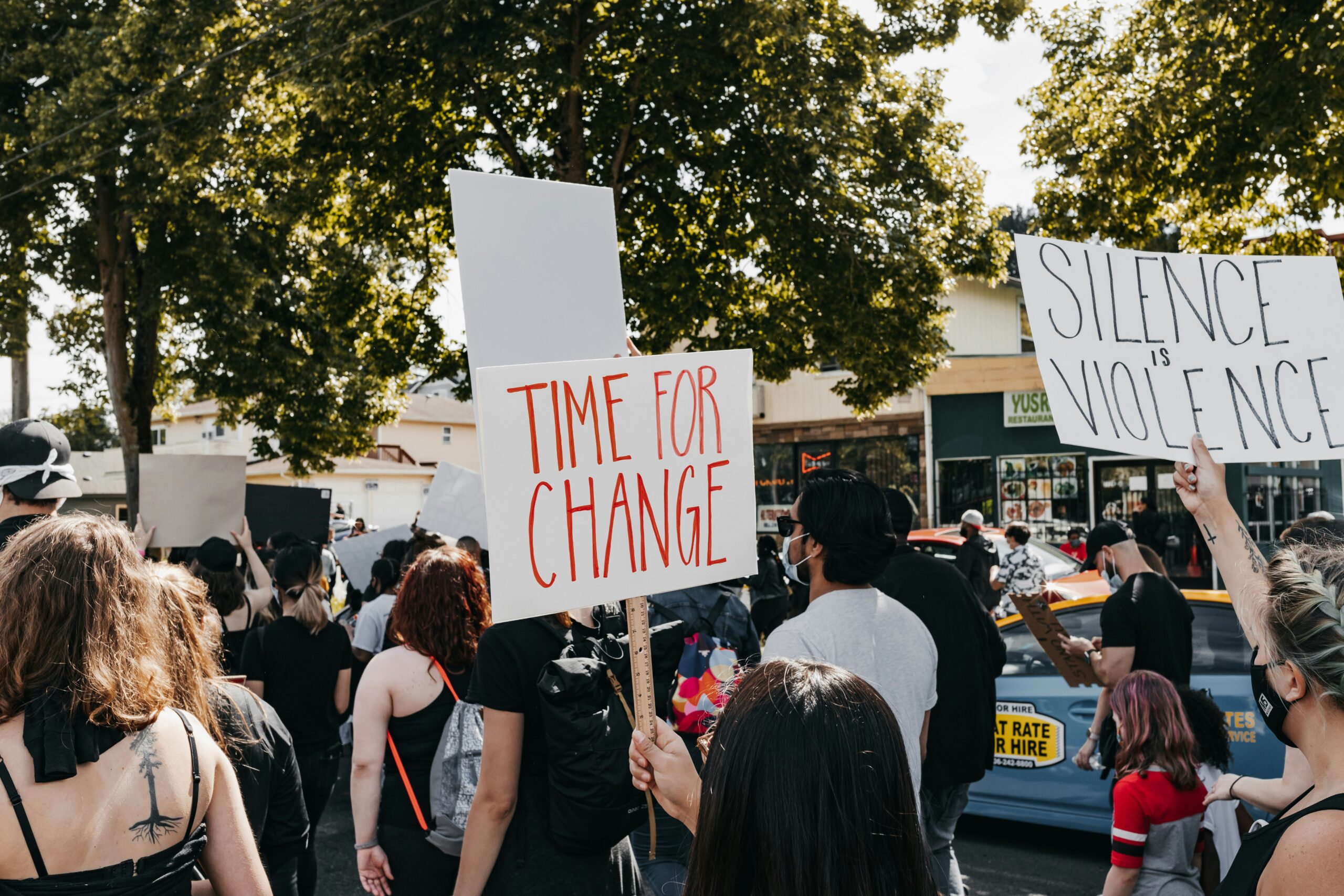
Disclaimer: Please be advised that these questions are not to discourage you from attending protests nor attack your previous or current behaviour during protests.
1. Do I know my right of peaceful assembly?
The right of peaceful assembly is a fundamental human right. It is protected by article 20 of the UDHR1. Another right directly linked to the right of peaceful assembly is the right to freedom of expression protected by article 19 of the UDHR. The declaration is not binding; however, it is part of international customary law. Ideally these rights are protected both nationally and internationally through the UDHR and the ICCPR2– with certain reservations. These rights are highly interlinked as people with common principles and values join each other and speak up against socio-political injustices.
Misconceptions conclude that undemocratic governments are the most prominent oppressors of human rights and more specifically the right to peaceful assembly and to freedom of expression. But we mustn’t forget that even democracies violate these rights. We need to be aware of the protest’s climate and the people’s true intentions in practicing these rights. Additionally, it is far more dangerous to have oppressive democracies than oppressive authoritarian regimes. The latter are blatantly oppressive; they don’t disguise themselves as liberal societies. They are certainly in the wrong, but these characteristics are an integral part of their governance. The purpose of these questions is not to delve into the different types of governments and governance; thus, this brief comparison ends here.
In today’s climate, knowing and understanding these rights are important to practice them and stay safe at the same time. There are no “factual” reasons for people not to be able to enjoy these rights. In most cases, governments excuse their behaviour and decisions to stop protests with two logical and legal yet inaccurately enforced reasons: national security and public safety. They excuse themselves with these reasons to silence people.
2. Do I know the police’s obligations at protests?
In most cases, whether it is in France with the “Gilets Jaunes” Movement, in the USA during the Black Lives Matter protests, in Lebanon during the 17 October Protests, in Germany with Climate Activists, in Serbia with the Student Movement, or even in the UK with the most recent Palestine Action demonstration, police uses excessive force to the point of brutality against demonstrators and civilians to oppress their cause.
With that in mind we might need to re-phrase that question and ask, “Does the police hold and respect its obligations towards protesters?”
In recent years, human rights organisations recorded an increase in police brutality and use of excessive force during protests across the globe. One can say that law enforcement across countries is divided by language but united by the abuse of power and the use of violence. Under all types of governments, whether described as democracies, authoritative or authoritarian regimes, disproportionate and unnecessary use of force is far too common.
Media coverage and human rights monitors recorded disproportionate use of firearms, batons, rubber bullets at close range, water cannons, and tear gas on peaceful protesters. Records have also shown that, in these circumstances, protesters’ behaviour indicated no signs of danger to the public. Police’s obligation during protest is to ensure public safety and protection which includes protesters and demonstrators. For instance, in cases where people start damaging private and public property, proportionate police intervention is certainly necessary. However, during sit-ins on public streets, assaulting protesters forming a human chain and dragging them to arrest them is a violation of the right to peaceful assembly and an abuse of power by law enforcement. This must be stopped. Standing up for human rights and social justice must not cost people their lives, their safety, and their bodily autonomy. Yet, it is the case due to ongoing violations of laws, policies and regulations by law enforcement agencies backed by governmental decisions.
Law enforcement officials must protect the safety of the public whether they’re bystanders or protesters. Escalating the situation with the unnecessary use of firearms, tear gas and water cannons to disperse the peaceful crowds, shut down the protest and provoke violent reactions is unlawful.
3. Do I understand the purpose of this exact protest?
People often rally to join the masses without fully understanding the reason behind the protest, the march, or the demonstration. One needs to be able to explain either their own personal choice for joining or the general overview of the protest’s goals and demands.
By asking this question and being able to properly answer it, protesters can defend themselves and their cause confidently and with ease. If there’s a lack of information; a quick research, a question to a friend and trusted people is the fastest route.
Opposition can be present at demonstrations, and no one can truly forbid them from attending a public protest. Your duty is to be unaffected by their presence and to ignore their provocations. If you happen to engage in a conversation or a debate with these people, you need to possess the correct information to win.
This question right here is the perfect example for you to prepare yourself against any opposition. By knowing and understanding the reason behind the protests and are confident with your arguments you do not need to worry. However, you need to be careful when engaging in a conversation or in a debate with the opposing public.
Provocation and inciting violence are two generally known tactics used to disrupt and cause chaos. Your job and responsibility are to not fall for them. Do not fight fire with fire. You know why you’re attending. You know it is a just cause. All you must do is rise above all altercation. Be argumentative. Be bold. Be loud and be proud. And most importantly do not lower yourself to their level.
When you’re capable of answering these questions, you are more confident with participating in protests and marches. You know your rights, you know you’re well surrounded by people who share the same principles and beliefs as you. You are aware of law enforcement’s obligations and most importantly you understand your civil liberties and your limits.
These next three questions might sound repetitive but they aren’t. Each question tackles the intention and behaviour of protesters from different perspectives.
4. Am I joining just to cause trouble?
Asking this question doesn’t mean you have ill intentions and are automatically categorised as an instigator of violence. This question reminds you of your presence on the streets and its impact. No matter your social, economic, religious or ethnic background, your defence of civil liberties is positively impactful. Each individual participating in a protest must believe that they are an ambassador of social justice. Thus, must act with respect and the best intentions.
It has been occasionally reported that radicals and troublemakers join protests for the sole purpose of destruction consequently disruption. For instance, the destruction of public and private property by troublemakers as reported by journalists on the ground during the 2023 wave of pension protest in France.
This question is mainly directed at this type of behaviour. Instigating violence, consequently turning peaceful protests into chaos, and causing the use of excessive force by law enforcement can only be perceived as a calculated attempt by higher-ups to silence people. Taking part in the oppression of peaceful protesters, fighting for human rights and decent living, defeats the idea of equality and dignity for all. That’s not human progress. Encouraging this divide in society can only regress social, economic, political and cultural liberties.
5. Am I willing to respect the principles of « peaceful protest » all through out the march?
In continuation with the previous question, respecting the principles of “peaceful protest” targets actual protesters; people who tirelessly work and defend the different goals of marches. By asking yourself this question, you remind yourself how important it is to stay calm and collected. Your willingness to respect the principles of peaceful protest is going to be challenged by opposition, provocative acts, troublemakers and law enforcement. Your role is to step back and assess the situation.
When chaos erupts you won’t always have time to evaluate your surroundings. That is why you need to think about your actions and behaviour prior to participating. It is difficult. It is challenging. Nevertheless, the fight for social justice is not meant to be easy. For your own safety, if you don’t believe you’re capable of acting peacefully, refrain from going. Engage in a different way.
Your involvement and activism can be expressed in different ways. Don’t feel as if your participation in protests is the only impactful road. This approach also applies to those who can’t attend protests for any other reason. Lobbying, digital activism, community organising, cultural action, boycotting, and whistleblowing are different types of activism you can get involved in.
6. Am I able to control myself if others incite violence?
Peer-pressure is highly present during protests. For this exact reason, demonstrators must show restraint when others – opposition, troublemakers, and law enforcement officers – incite violence. Verbal provocation can be the trigger pulled at demonstrators to transform them into a disruptive mass. Protesters should, as mentioned previously, rise above it. Ignore as much as they can.
In cases where law enforcement launched assaults at protesters, the latter reacted. It is a natural response to defend themselves. The purpose of this question isn’t to discourage people from defending themselves against police brutality. On the contrary, protesters shouldn’t surrender when wrongfully attacked. However, as a demonstrator your response should be well calculated. Take cover, retreat, check on fellow protesters, help those hurt or injured. Make sure that your responsibility, in this scenario, is to bring calm to the chaos.
Violence is not the answer. You’re taking part in a protest, practicing your right to peaceful assembly, enjoying your right to freedom of expression, and fighting for a social, political cause. This shows that you respect democratic values and civil liberties. You need to be able to uphold that. Be better than those you’re protesting.
7. Is disrupting circulation and blocking traffic a transgression?
In normal situations, the short answer is YES. Depending on local laws, each country has a different approach when it comes to road blockage. With either an in advance request or through an unplanned march, road blockage is generally illegal. However, rerouting is implemented by local authorities for march requests to ensure public safety and security.
When circulation is rerouted and alternatives are put in place, protesters are not causing road blockage. Road blockage by demonstrators is an unlawful barrier created by unsafe obstacles such as public bins, rubbish, car tires, benches, cars, etc. It has been noticed among activists, that road blockage is unfavourable to their causes. They generate negative impact on public opinion.
What cannot be considered as a transgression is a full-on march designed to pass through a whole city or major squares where circulation can be redirected by authorities. The circumstance in which these regulations are applied and to be respected are peaceful protests. This clarification doesn’t intend to criticise uprisings and rebellions. These cases are completely different. The question at hand doesn’t discredit uprisings, it just doesn’t tackle them.
Remember these questions and ask yourself and others if they’re capable of answering them in full honesty before taking part in a protest or a march.
These tips are here to frame your knowledge to better understand human rights standards at the international, regional and national levels when it comes to the right to assembly. For more information on the national level, you can look up your country of birth and/or residence’s legislations and laws. The incorporation of international treaties in legislation is not automatic nor mandatory which makes situations harder in certain countries.
- Universal Declaration of Human Rights (1948)
- International Covenant on Civil and Political Rights (1966)